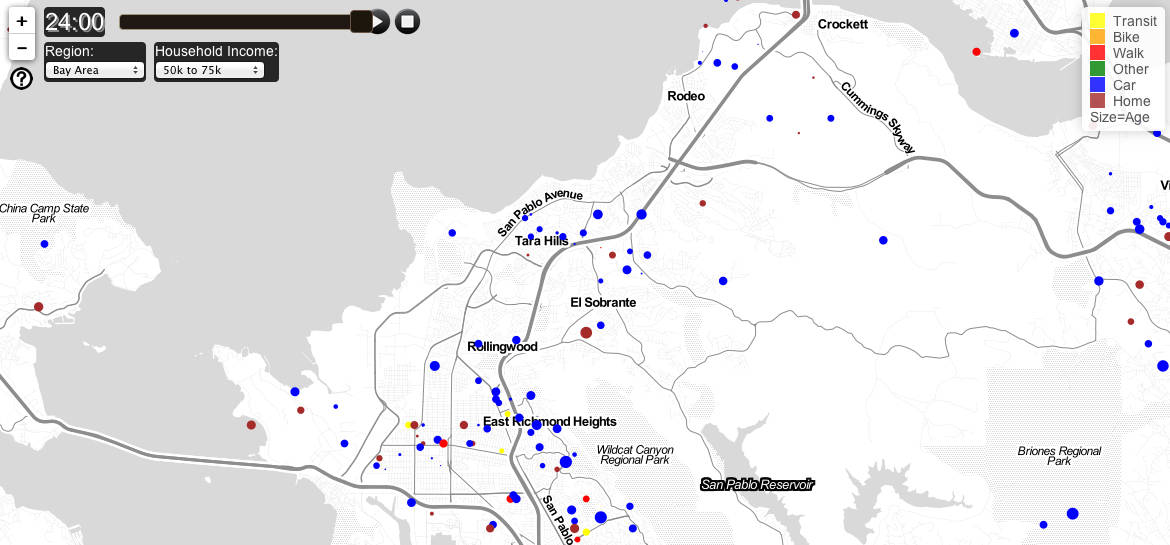
(A still of commute patterns in the East Bay. Screen grab via: Activemaps)
Data is an empowering and effective tool for better understanding our everyday lives, and when that information can be easily digested through visuals we are all the more grateful. With this in mind, a thank you is due to UC Berkeley planning Ph.D. student Fletcher Foti, who recently compiled commute patterns in greater New York, Los Angeles, and the San Francisco Bay Area, and created an interactive visualization called “Active Maps.” Active Maps shows a day of travel from recent travel surveys and can be sorted by income and zoomed to specific areas. Each circle represents a person, and the size of the circle represents the age of the person. When looking at the East Bay, it’s interesting to note regardless of income, transit and walking appear to be most prevalent around Berkeley and Oakland whereas the surrounding parts of Alameda and Contra Costa County appear more car-dependent.
For additional coverage, visit The Atlantic City and San Francisco Streetsblog.
*(Note: the default map is for New York, though you can click on the drop-down bar to select the San Francisco Bay Area)




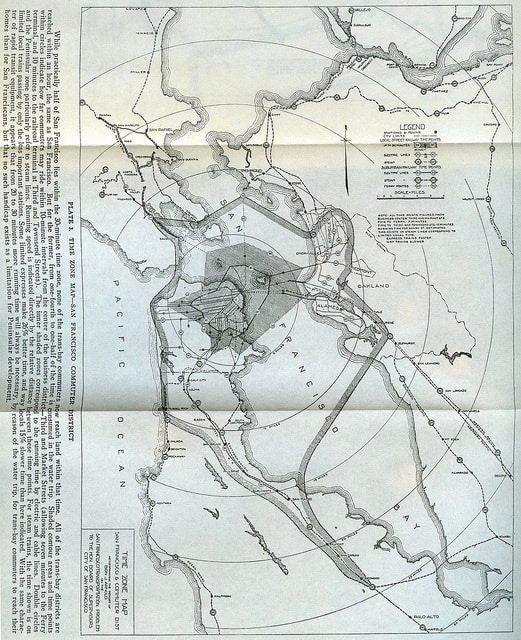 While practically half of San Francisco lies within the 30-minute time zone, none of the trans-bay commuters now reach land within that time. All of the trans-bay districts are reached within an hour, the same as San Francisco. But for the former, from one-fourth to one-half of the time is consumed in the water trip. Shaded contour areas and time points within circles indicate how far commuters may ride within 10-minute intervals from the center of the business district-Third and Market Streets (allowing seven minutes to the Ferry terminal, and 10 minutes to the railroad terminal at Third and Townsend Streets). The inner shaded zones correspond to the running time by electric and cable lines. Double circles and the Peninsular zone particularly refer to steam lines. Running speed is indicated directly by the relative distance between these time points. For steam trains, the time shown is on limited local trains passing by only the less important stations. Some limited expresses make 26% better time, and way locals 15% slower time than here indicated. With the same character of rapid transit equipment, it appears that from 20 to 30 minutes more running time will always be necessary, by reason of the water trip, for trans-bay commuters to reach their homes than for San Franciscans, but that no such handicap exists as a limitation for Peninsular development.